
If Humans Were Killed at the Same Rate as Animals for Food, We'd Be Extinct in Just 2.5 Days
Yes — all 8 billion of us. And what that means for our future and choices.

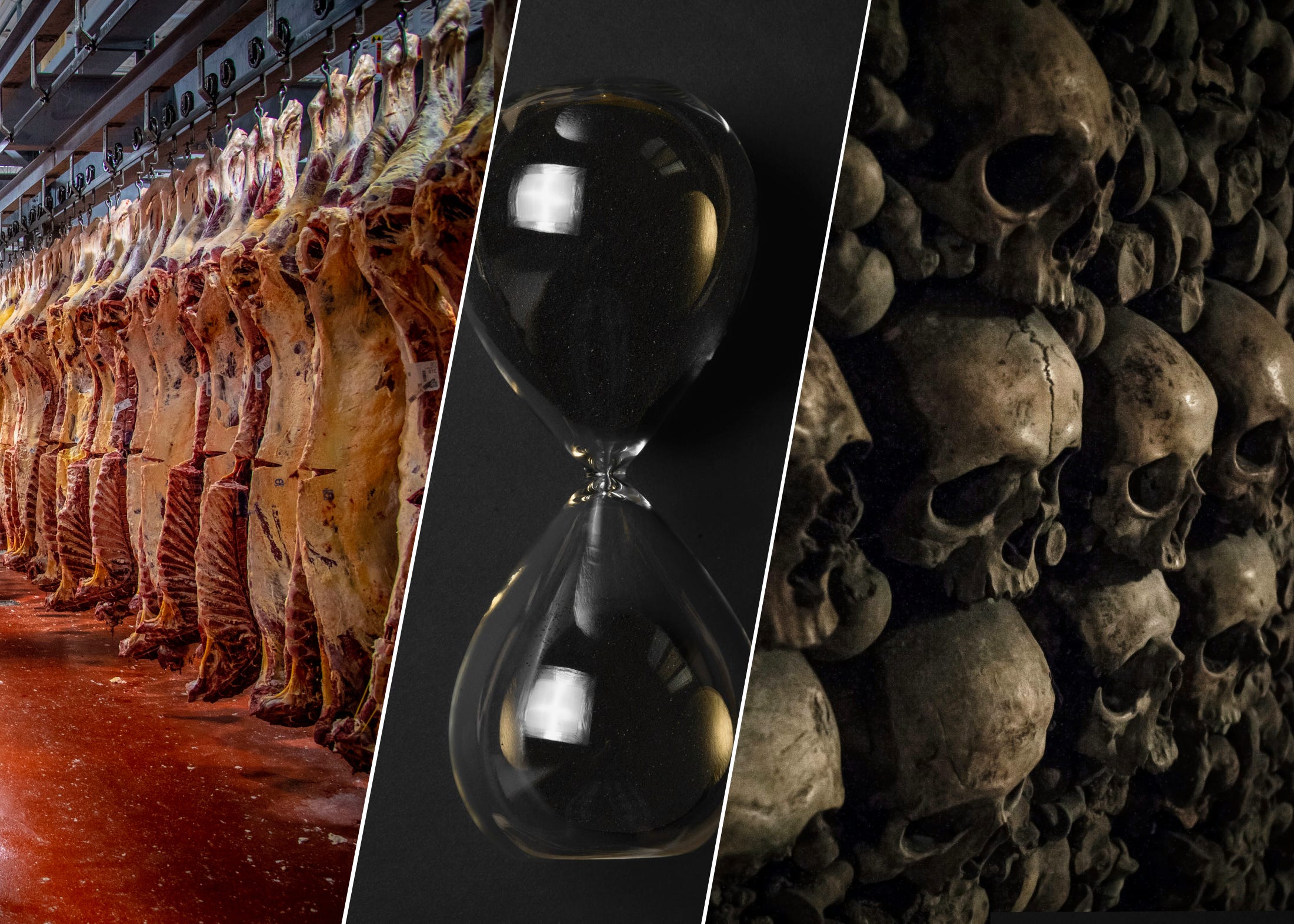
A great deal happens in our world — much of it behind closed doors. We can’t keep track of it all. But some realities are too vast, too consequential, to slip from our awareness.
Today, we’ll confront one of them. Using carefully vetted data, I will illustrate the staggering number of animals killed for food by comparing it to a more relatable figure — the size of the global human population.
First, I’ll walk you through the calculation. Further below, you’ll find a breakdown of how these figures were derived, along with my responses to common critiques and objections. Together, we’ll explore what these numbers mean — not only for the animals but also for our lives, our planet, and our choices. Read on!
How Many Animals Are Killed Every Day?
Based on the most conservative estimates, here’s what we find:
Land animals: about 234 million killed per day
Farmed fish: about 106 million killed per day
Wild-caught fish: around 3 billion killed per day
→ This adds up to a staggering 3.3 billion animals killed every single day for human consumption.
Why include fish? Because for an honest reflection on animal suffering, the total number matters. Although fish can’t vocalize pain like other animals, scientific research indicates they can feel pain and suffering. For those interested, I’ll also include a separate calculation below that covers only land animals.
What If Humans Were Killed at the Same Rate?
To understand the scale of animal slaughter for food, imagine how quickly humans would be wiped out if we were killed at the same rate. The current global human population is around 8.2 billion.
All Animals: 60 Hours to Extinction
If humans were eliminated as quickly as animals are killed for our consumption, the entire human race would be gone in just under 60 hours — less than two and a half days:

Land Animals: 35 Days to Extinction
About 85.4 billion land animals are killed for food every year — more than ten times the entire human population. If humans were killed at that rate, all of humanity would vanish in just over a month:

Why Are These Estimates Highly Conservative?
The animal death counts shared above are deliberately selected with the utmost caution. The real figures are likely much higher — here’s why:
Unreported and Illegal Activities: Unofficial fishing, wild hunting, and illegal farming practices are largely missing from official statistics.
Incomplete Animal Coverage: Many animals eaten by people in various parts of the world — such as dogs, cats, crabs, octopus, lobsters, shrimp, insects, frogs, and turtles — are not included, often due to the lack of reliable data or because numbers are reported by weight rather than by individual counts.
Data Age and Trends: The best available data are from 2019–2023, but global animal consumption is still increasing rapidly. Therefore, it’s reasonable to assume that current numbers are even higher than those recorded during this period.
Lowest Estimates Chosen: Where sources provided ranges, I consistently selected the lowest numbers to avoid exaggeration. Some sources suggest actual numbers could be more than twice as high as these estimates.
I’ve chosen this cautious approach to ensure the figures in this article are hard to dispute and to prevent any accusations of overstating the facts — though billions, likely trillions, more animals suffer beyond these counts and deserve just as much recognition and action.
Addressing Common Objections
When drawing comparisons like the ones in this article, it’s common for some objections to arise — especially from those who aren’t deeply familiar with the topic. While these concerns are understandable, they don’t hold up in this context and can be refuted quickly:
“But you can’t equate animals with humans.”
→ This objection is fundamentally misguided and self-defeating for a number of reasons, which I outline here.
“The enormity of these numbers just proves that my personal consumption choices won’t make a difference.”
→ This is a dangerously mistaken belief. Many consumers think this way, and it’s actually one of the reasons behind some of our biggest global challenges. I explain why here.
“Growing plants can also harm and kill animals.”
→ That’s true, but it’s not a good argument to defend the exploitation of farmed animals. In fact, it actually strengthens the case against it, because plant-based diets require far fewer plants overall than diets based on animal products.
It’s Not Just About the Killing
The staggering number of animals slaughtered every day is only part of the story.
Farmed animals don’t just face death — they suffer through lives of forced breeding and confinement. Most never see the sun, feel grass beneath their feet, or breathe fresh air. In factory farms, where the vast majority of farmed animals live, they are robbed of any chance at a life worth living. The brutal conditions cause millions upon millions to die long before they even reach slaughter.
Animal farming also fuels some of the most severe ecological and public health crises of our time — urgent threats to our very survival.
If we care about our future and want to live with compassion, this madness must end.
Generations to come will look back on these facts with horror — and so should we. In a society where this cruelty and destruction is no longer necessary, it’s our responsibility to act.
The good news? Major change is already underway. In recent years, millions have embraced more compassionate lifestyles, refusing to fund animal exploitation with their spending — and that number continues to grow every day. If you ever feel your hope fading, you might find renewed inspiration here.
Data Sources
1) Land Animals
According to the Food and Agriculture Organization (FAO) of the United Nations, these are the numbers of animals killed for human consumption in 2023:
Chickens: 76,245,629,000
Ducks: 4,188,010,000
Pigs: 1,511,950,905
Geese: 788,804,000
Sheep: 695,482,414
Goat: 543,794,638
Turkeys: 521,969,000
Cows: 309,870,057
Rabbits and hares: 482,537,000
Other domestic rodents: 70,647,000
Pigeons and other birds: 47,653,000
Buffalo: 28,519,240
Horses: 4,705,400
Camels: 3,044,684
Other domestic camelids: 966,579
Donkeys: 958,419
Mules: 98,327
→ Estimate: A total of 85.4 billion land animals are killed per year, which equals about 234 million land animals killed per day.
2) Fish
Fish are difficult to quantify accurately due to their extremely large catch numbers, the wide variety of species involved, and inconsistent reporting standards across countries. As a result, estimates tend to have quite wide ranges.
2a) Farmed Fish
According to Sentience Institute (estimate based on FAO data): 38.8–215.9 billion farmed fish killed in 2019.
According to Our World in Data: 86–180 billion farmed fish killed in 2022.
→ Lowest Estimate: 38.8 billion farmed fish are killed per year, which equals about 106 million farmed fish killed per day.
2b) Wild-Caught Fish
Based on a detailed analysis, Mood & Booke (2024) estimate that 1,100–2,200 billion (or 1.1–2.2 trillion) wild-caught finfishes were caught annually, on average, during 2000–2019.
→ Lowest Estimate: 1.1 trillion wild-caught fish are killed per year, which equals about 3 billion wild-caught fish killed per day.
Vegan Horizon is made possible by readers like you. If you'd like to support this project and help it grow, please consider joining as a free or paid subscriber.

It’s truly amazing how many parents and grandparents will do literally anything for their descendants, excluding dumping animal products.
Truly illuminating not to mention mortifying statistics regarding the almost unimaginable scale of mass murder committed by Homo sapiens with regards to other non-human life forms on Earth. 🌎
ManUnkind has my vote for being the most savage and bloodthirsty creature to ever exist. How human beings could have become so irredeemably monstrous truly boggles the mind. Through some sort of mental and moral gymnastics, most seem to accept this level of unmitigated barbarism as “normal behavior” and just, which I find to be utterly astonishing.
Curious how when non-vegan humans look in the mirror they fail to see the face of an unrepentant serial killer.