
Veganuary Is Under Attack: How a New “Forget Veganuary” Campaign Misleads the Public
This provocative “alternative” to Veganuary fails animals, logic, and common sense

You may have seen it in the news:
“Veganuary cheerleader quits to run meat-eating campaign — after decades combating animal cruelty”
Toni Vernelli spent nearly six years as Head of Communications for Veganuary, one of the most influential vegan campaigns in the world. Now, she has taken a striking new direction, becoming the public face of a provocatively titled new initiative: “Forget Veganuary.”
The message?
Don’t bother changing your diet. Keep eating meat — and instead donate money to animal welfare charities.
In this post, I break down why the Forget Veganuary campaign is misguided and deeply concerning.
As similar campaigns are likely to become more common, my goal is to ensure you’re equipped to spot and challenge these misleading tactics.
Why the Forget Veganuary Campaign Is So Problematic
1) Ignoring the root problem
Charitable interventions like the ones promoted by Forget Veganuary may reduce some suffering for farmed animals, but they do not address the fundamental fact: sentient beings are exploited and killed for products we do not need.
The most effective way to help animals is not to pay to “offset” harm after it occurs, but to prevent it from happening in the first place.
Animal farming is by far the largest organized act of violence in human history, and there is no justification for it.
The victims deserve that we work to end this atrocity — and that we refuse to dismiss this goal as unrealistic from the outset, especially when tens of millions of people are already living vegan and proving that change is possible.
2) Claiming your choices don’t matter
A central claim of the Forget Veganuary campaign is that veganism — and reducing animal product consumption more broadly — doesn’t meaningfully reduce animal suffering. This is demonstrably false.
It ignores the real-world impacts of collective consumption shifts that are already visible, such as the rise of better plant-based alternatives and the expansion of plant-based sections in supermarkets.
It’s a simple truth that shouldn’t need explaining: something you do 2-4 times a day, for roughly 26,000 days of your life, inevitably makes a difference.
A single person choosing a plant-based diet spares many animals, including over 100 vertebrates each year. Few decisions have such concrete, far-reaching benefits across so many areas as choosing to live vegan.
3) Promoting a flawed “offsetting” logic
Forget Veganuary markets its solution as “like carbon offsetting, but for your diet.”
That comparison should worry everyone.
Carbon offsetting has repeatedly been shown to fail due to systemic problems — low quality schemes, grossly exaggerated claims, and moral licensing that leads people to consume more, not less.
Animal suffering works the same way. Paying to “offset” harm after the fact is like deliberately setting a fire and then donating to the fire brigade. With animal products, the problem is even more severe than with carbon emissions, because the damage inflicted on the victims is irreversible.
4) Claiming veganism and donating can’t go together
The Forget Veganuary campaign implies that people must choose between changing their consumption habits and donating to animal charities. This is a false dichotomy: the two are not only compatible — they reinforce each other.
Reducing or eliminating animal product consumption addresses the root cause of the harm, while donations often focus on mitigating its consequences. These strategies work best together, not in opposition.
In fact, I know more vegans who actively support animal charities than non-vegans — and that makes sense. For many people, it is precisely veganism that sparks deeper research and awareness of the full scale of animal exploitation, leading to greater long-term engagement, including charitable giving.
One of my supporting subscribers, Sarah Benn — who made headlines as the first UK doctor to be jailed for climate activism — is a perfect example. She says her “most profound realizations about the cruelty and environmental harm of the animal industry came only after fully committing to a vegan lifestyle.”
5) Attacking people who care for animals
The Forget Veganuary campaign website doesn’t offer a complementary approach — it ridicules veganism outright. Veganism is framed as impractical, extreme, and almost impossible. There’s even a bizarre mini-game mocking the idea of giving up animal products, even temporarily.

The campaign was immediately picked up by the media and framed as a major failure of the vegan movement — especially given that front figure Toni Vernelli abandoned vegan activism.
Considering the campaign’s carefully timed launch to coincide with Veganuary and its provocative approach, it’s reasonable to conclude that the media’s anti-vegan response was exactly their plan — a direct and hostile attack on a movement whose sole purpose is to reduce needless animal suffering.
6) Relying on welfare fixes that don’t go far enough
While it’s important to reduce the suffering of farmed animals wherever possible, Forget Veganuary’s approach of placing all hope in welfare alone is misguided.
Even where so-called “humane” standards exist, they are often applied inconsistently and serve more as marketing tools than to protect animals. Countless investigations have shown that claims of humane treatment are misleading. An in-depth article in The Guardian concluded, “There’s no such thing as humane meat or eggs. Stop kidding yourself.” Experts widely agree that terms like “pasture-raised,” “humane,” “responsible,” and “cage-free” are often deceptive, fostering misplaced trust in an industry that has done little to earn it.
The animal agriculture lobby cares about profit, not animals. They fight hard — and often ruthlessly — against even the most basic animal welfare reforms. The assumption that a few donations could overcome this entrenched resistance is delusional.
7) Ignoring environmental, health, and social harms
The welfare-focused approach of Forget Veganuary also completely overlooks many systemic harms caused by animal agriculture: environmental damage, climate impacts, and public health risks are inherent to the industry — not fixable through welfare tweaks.
In many areas, animal consumption is among the largest contributors to environmental degradation, social injustice, and health crises worldwide. Ignoring these consequences means missing the bigger picture of why lifestyle change matters.
8) Pushing for more animal product consumption
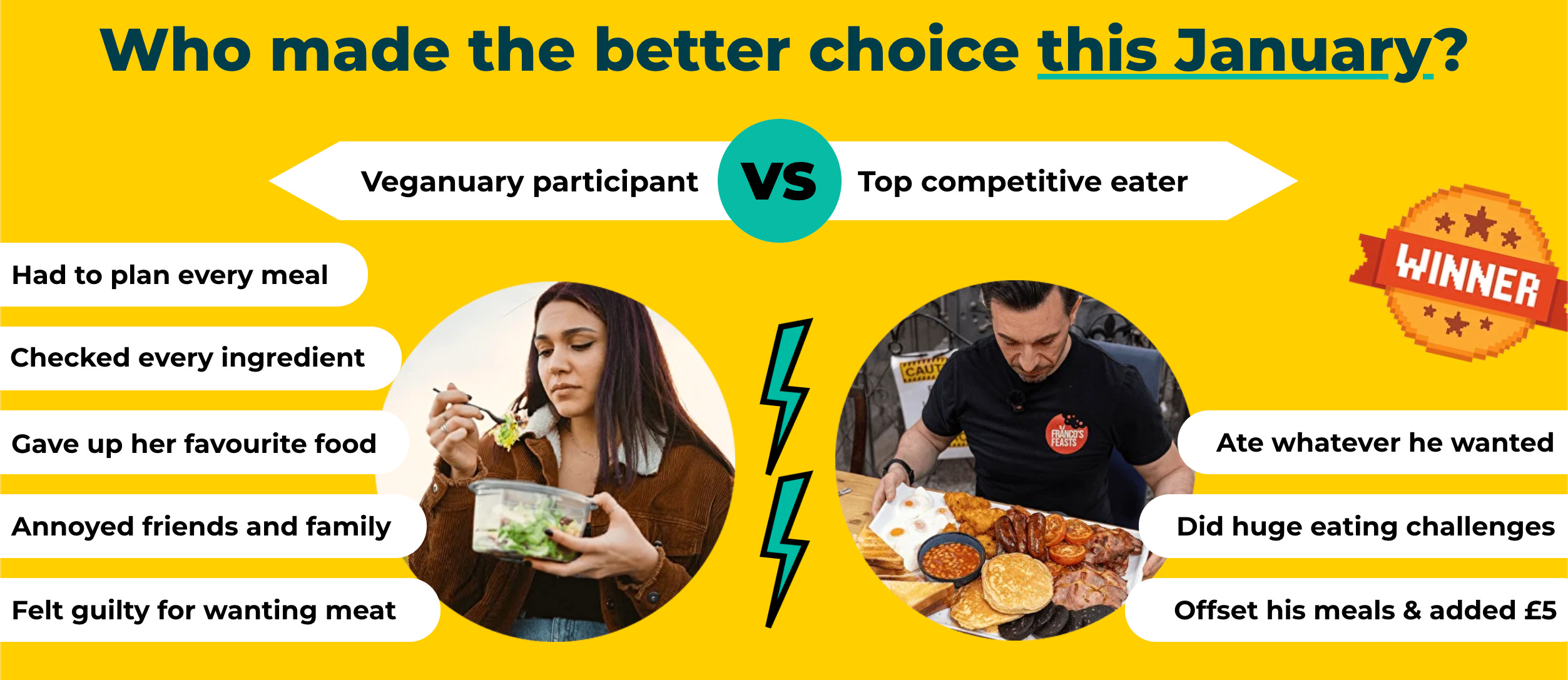
The Forget Veganuary campaign actively encourages increased consumption of animal products. To promote the campaign, it partnered with three of Britain’s top competitive eaters, who spent an entire day eating nothing but animal-based meals for breakfast, lunch, and dinner. The campaign’s website even prominently features an image of one of these men, labeled a “Winner,” in front of a plate piled with animal products.
Let’s be absolutely clear: no campaign genuinely committed to reducing animal suffering would ever advertise itself by encouraging more animal consumption — especially in a world where nearly all animal products come from factory farms. This approach is deeply contradictory and undermines any claim to ethical concern for animals.
9) Using flawed data to suggest vegans often quit
A claim pushed by the Forget Veganuary campaign is that many vegans end up going back to eating animal products, implying veganism is unhealthy or unsustainable. This is misleading.
The study most often cited to support this claim — a survey conducted by the Humane Research Council (HRC) — says that “84% of vegetarians/vegans abandon their diet”. However, the survey has serious flaws and is contradicted by larger studies showing most vegans stick with their diet.
Using the HRC study to attack veganism also ignores a basic fact: nearly all diets have high dropout rates — around 97% on average. By that standard, veganism actually performs quite well.
It’s also worth noting that the HRC study is severely outdated, having been published in 2014. Since then, plant-based eating has become more mainstream, socially accepted, and far easier to stick with thanks to better and more widely available alternatives.
Conclusion
The Forget Veganuary campaign is a no-win strategy: attacking veganism doesn’t help animals, it only undermines a movement that has already achieved real progress.
As I’ve shown in this article, Forget Veganuary’s “offsetting” approach is seriously flawed and built on a series of misleading claims.
Some of their tactics are so absurd that it’s hard not to wonder whether there are hidden interests behind their supposedly “philanthropic” funding — or whether the people involved are genuinely naïve enough to believe their own claims.
If you care about animals, cutting out animal products remains the most direct and effective way to prevent suffering — tackling the cause, not just the symptoms.
The Veganuary team has done tremendous work to advance this cause, and now it’s our turn to support it:
Share this post widely to expose the misleading campaign that seeks to undermine their efforts.
Encourage others to join Veganuary this January — or to take part in other vegan challenges, like Challenge22, throughout the year.
Together, we can turn this smear campaign back on itself — and continue driving real, meaningful change for animals.
Thank you for reading
Vegan Horizon is a reader-supported publication. If you’d like to support this project and help it grow, please consider joining as a free or paid subscriber. Sharing my articles and recommending this newsletter also helps tremendously, as I rely on word of mouth to reach more people. Thank you for stopping by. 💛
Wow... I wasn't aware of this, and particularly mocking veganism by the carnivore competition, is the world in which we find ourselves. Quite distressing... thanks for keeping us informed.
While I think FarmKind appeals to a segment of people who struggle with their dietary situation/want to help animals/care about the environment, this campaign was misguided.
No hardcore "animals-are-just-food" carnivore (the demographic that enjoys ridiculing vegans and is likely the only group strongly aligned with this kind of messaging) would donate to 'offset' meat consumption.